When the Universe Learned to Shine
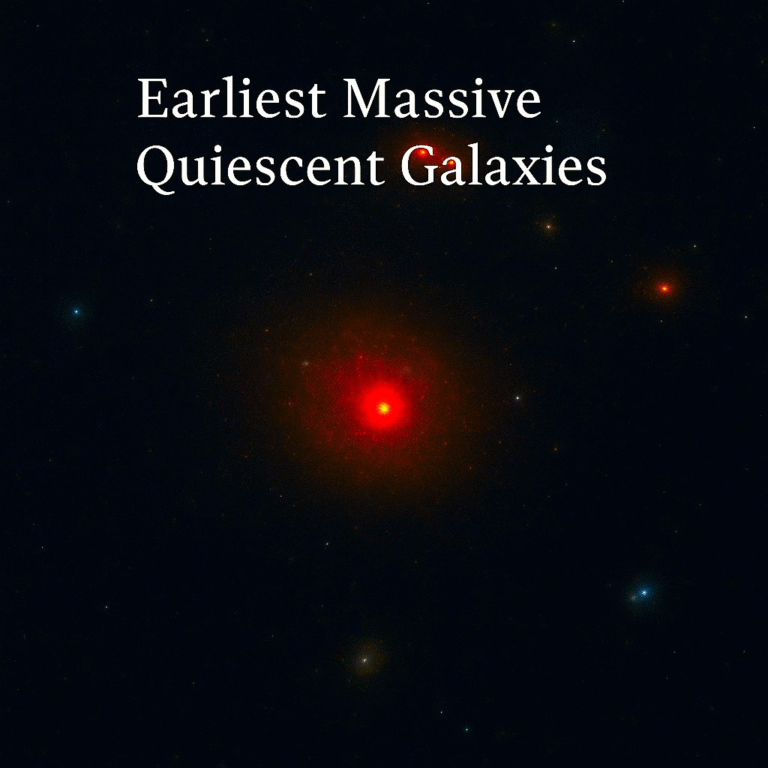
Amid the young universe’s brilliance, I search for galaxies that have already fallen silent. Using large-area JWST surveys, I chart the cosmic number density and variance of quiescent systems beyond z > 3, rare monuments to an early, rapid transformation.
Massive galaxies that quenched within the universe’s first two billion years present one of the deepest puzzles in galaxy evolution. How did such systems assemble so rapidly, and why did they fall silent so soon?
To address this, I am combining JWST/NIRCam data from both legacy extragalactic fields and new pure-parallel programs, creating an unprecedented dataset that balances depth and area. This combination not only ensures large-area coverage, dramatically reducing the cosmic variance that has long limited our understanding of early quenching, but also enables, for the first time, a direct measurement of the spatial fluctuations in the number density of quiescent galaxies at z > 3.
These fluctuations provide a new, powerful connection between the earliest quiescent galaxies and their underlying dark matter halos—revealing where, and in what kinds of environments, galaxies first shut down their star formation. By quantifying both the abundance and clustering of these systems, my work aims to uncover how the first massive galaxies transitioned from starburst to silence, and how their halos shaped the emergence of structure in the young universe.
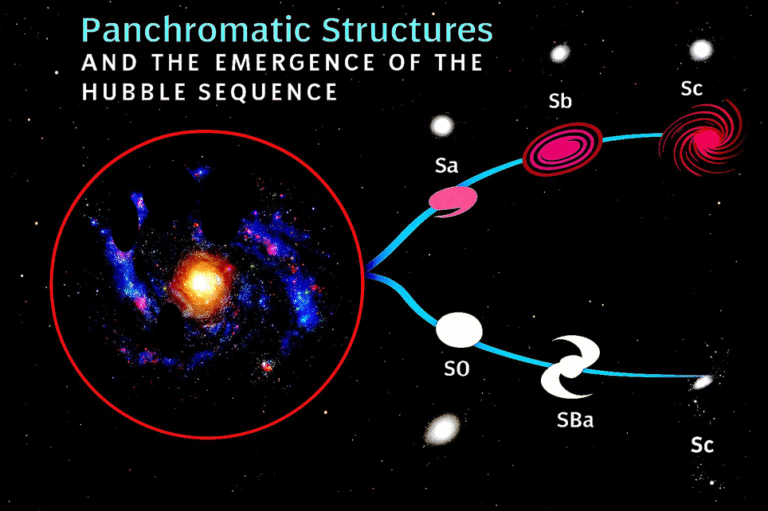
I then turn to the structure of the earliest quiescent galaxies, weaving together light from stars, dust, and cold gas to reveal how they took shape after their firestorm of creation. In their compact forms and fading glow, I trace the first hints of structure: the quiet symmetry from which the Hubble sequence is first unfolding.
Even in the JWST era, most studies of early quiescent galaxies have focused only on their stellar light. But galaxies are ecosystems, where starlight, dust, and cold gas interact to shape their evolution. To understand why the earliest massive galaxies stopped forming stars, we must look beyond stellar emission and trace their panchromatic structures.
Such a view was, until recently, out of reach—the faint dust and gas emission from these distant, quiescent systems lay below detection limits. I pioneered the first JWST/MIRI and ALMA detection of dust emission from a quiescent galaxy at z = 4.7, unveiling extended dust emission surrounding a dense, quenched stellar core.
As Principal Investigator of the ALMA Cycle 12 program ASHES—a 45-hour Band 7 survey at 0.2″ resolution—I am assembling the first resolved view of the cold interstellar medium in every spectroscopically confirmed quiescent galaxy at z > 3.5 visible to ALMA. Together with NIRCam and MIRI, I am leading the first population-level panchromatic study of massive quiescent galaxies at z > 3, revealing how the interplay of stars, dust, and gas sculpted the earliest massive galaxies and gave rise to the Hubble sequence.
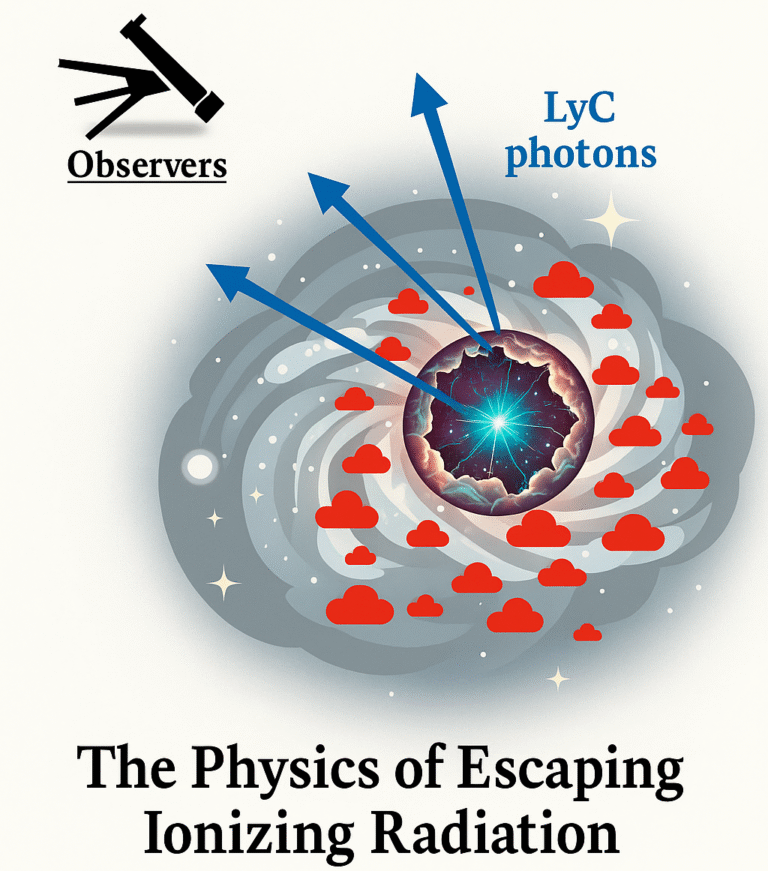
As my secondary research focus, I study galaxies still ablaze, tracing how ionizing radiation escapes through fractures of gas and dust to reach the intergalactic dark. Through their leaking radiation, I seek to understand how young galaxies reionized the cosmos.
The epoch of reionization marked the universe’s final great transformation, when the early galaxies and black holes ionized hydrogen and lifted the cosmic fog that lingered after the Big Bang. Which sources produced the bulk of ionizing photons (i.e., Lyman continuum, LyC), and how their radiation escaped into the intergalactic medium, are questions central to understanding how the modern universe emerged from darkness.
Directly detecting LyC emission during reionization is impossible—the intergalactic medium absorbs almost all escaping LyC photons. My research instead focuses on LyC-emitting galaxies at lower redshift, where escape can be observed directly. Using JWST, HST, and ground-based spectroscopy, I study the geometry, gas, and feedback that govern how radiation escapes. These galaxies serve as living analogs of the first light sources, revealing the physical processes that allowed early galaxies to reionize the cosmos.
Recently, I used JWST/MIRI imaging to detect dust emission from a confirmed LyC-emitting galaxy at z = 3.8—the first such detection. The observations uncovered a porous, asymmetric dust structure, with ionizing photons escaping through narrow channels carved by stellar feedback. This discovery demonstrates the anisotropic nature of LyC escape and offers a new view of how galaxies leaked radiation into the early universe, illuminating the physical origin of cosmic reionization.